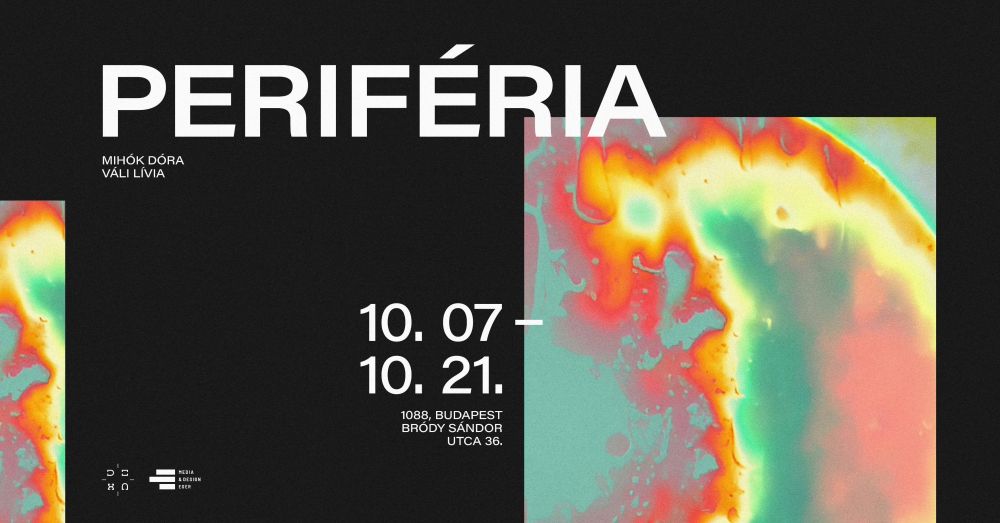
Dóra Mihók, Lívia Váli: “PERIFÉRIA,” an audiovisual live performance at DOXA
Opening: October 7, 2026, 7:00 p.m.
Venue: DOXA (36 Bródy Sándor Street)
Opening performance: Live audiovisual act by Dóra Mihók and Lívia Váli
Opening remarks by Rudolf Szilágyi, visual artist and lecturer at the Institute of Media and Design at Károly Eszterházy Catholic University
On view: October 7–21, 2026
•
As part of the gallery’s educational program, the collaboration between DOXA and Eszterházy Károly Catholic University launches in the fall of 2026. This year, DOXA is working with the Media and Design Institute of the university’s Faculty of Arts. Within this framework, four young artists will present themselves through two solo exhibitions and one joint exhibition at DOXA.
The aim of the collaboration is to provide visibility and an opportunity for emerging artists to introduce themselves, while also supporting their creative paths after university training. The exhibition series offers a chance for works created in the university environment to appear in a new context, outside the university walls, before a wider audience.
The second exhibitors in the series are Mihók Dóra and Váli Lívia, 2025 graduates of the Media and Design Institute at Eszterházy Károly Catholic University. Their audiovisual spatial installation titled *Periphery* explores the inner world of people pushed to the margins of society and living in isolation. It addresses life situations that are rarely discussed in everyday life, even though we often only see their surface. Life situations connected to the vulnerability of the intimacy of body and soul, as well as to addiction, are frequently judged on the basis of the image formed about them, while the feelings, burdens, and stories lying behind them remain invisible.
Two Hungarian short stories had a major influence on its visual and conceptual world: Géza Csáth’s *Opium* and Krisztina Tóth’s *The Key to Room 28*. Through different life situations, the two works reveal various forms of addiction, vulnerability, abandonment, desire, and detachment from reality. In *Periphery*, these states do not appear as concrete scenes; instead, they become the foundations of a fragmented, oppressive, and sensorially heightened inner world.
The installation presents the worlds of two different stories and two distinct life situations that unfold in the space in parallel and layered upon each other. The projected images and the disrupted spatial structure intensify the sense of vulnerability, brokenness, and inner fragmentation. The two worlds sometimes remain separate, at other times intertwine, just as the boundaries between reality and inner states become increasingly uncertain.
The artists themselves appear in the videos. The distortion of the face and body through various manual and digital techniques creates a sense of impersonality, objectification, and detachment from the body. The distortion is simultaneously linked to altered perception, to the inner tension caused by addiction and vulnerability, and to the prejudiced image that can form about a person pushed to the margins of society. In this way, the face and body gradually lose their familiar, personal meaning and become the carriers of an emptied, more soulless state.
The visual world is defined by vivid, intense colors and strong contrasts. These reinforce the sensation of altered states of consciousness, intoxication, and detachment from reality, while the imagery becomes simultaneously attractive, disturbing, and therefore oppressive. The vibrating colors, distorted bodies, and constantly changing projections create a stimulus-saturated environment in which the senses are heightened and the external and internal realities become increasingly difficult to separate.
In the sound design, the subtle sensory details of the two short stories come to life. Kisses, a languid heartbeat, a buzzing ear, city noise, shouts, and monotonous, repetitive sounds build the sonic environment. Everyday noises that are barely perceptible layer upon one another and become increasingly prominent, so that the soundscape also conveys the drawn-out mood, emptiness, and loneliness.
*Periphery* was also presented in the summer of 2026 as part of the Zsolnay Light Festival at the M21 Gallery in the Zsolnay Quarter, in the exhibition *Contemporary Perceptions*.
**Artists:** Mihók Dóra, Váli Lívia
**Thanks to:** Csontó Lajos, Szolnoki József, Major Alexa, Mucsi Emese, Szilágyi Rudolf, Yvette Vivien.
— as stated in the event description.

![Opening of the exhibition titled “Katharina Roters and József Szolnoki 56[ ]26 – The Shadow of the Blind Spot”](../res/imgcache/819629587_1713180200807196_9163386925510263126_n_rb800x600co.webp)
Opening of the exhibition titled “Katharina Roters and József Szolnoki 56[ ]26 – The Shadow of the Blind Spot”
Exhibition Opening: Saturday, October 10, 2026, at 5:00 p.m. Opening Remarks: Zsolt Miklósvölgyi, art writer and curator The exhibition will be on view from October 10, 2026, through November 15, 2026. Venue: Dubniczay Palace, Castle Gallery 29 Vár Street, 8200 Veszprém
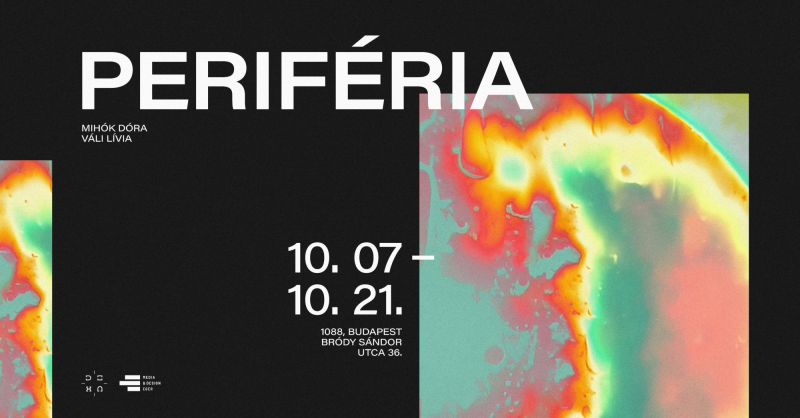
Dóra Mihók, Lívia Váli: “PERIFÉRIA,” an audiovisual live performance at DOXA
Opening: October 7, 2026, 7:00 p.m. Venue: DOXA (36 Bródy Sándor Street) Opening performance: Live audiovisual act by Dóra Mihók and Lívia Váli Opening remarks by Rudolf Szilágyi, visual artist and lecturer at the Institute of Media and Design at Károly Eszterházy Catholic University On view: October 7–21, 2026
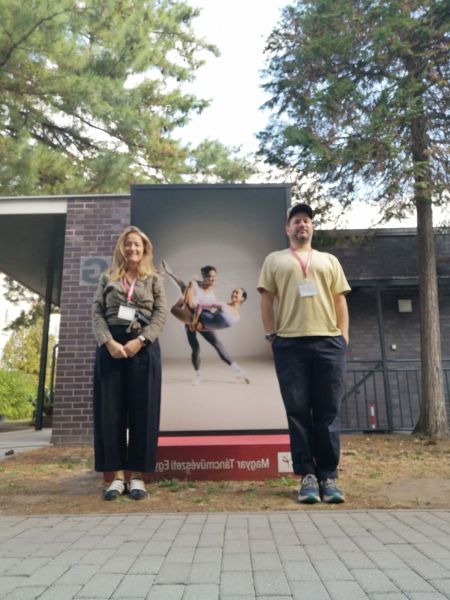
2. International Conference on Dance and Digitalization (ICDD 2026)
Our institute’s faculty member, Tarr Kálmán DLA, delivered a joint presentation with Dr. Dezső Renáta, senior research fellow at MOME, on September 25 at the Hungarian Dance Academy’s ICDD 2026 – Dance and Digitalization international conference
MA Project Week '26
Between September 14 and 18, the Graphic Design master’s program held its semester-opening project week